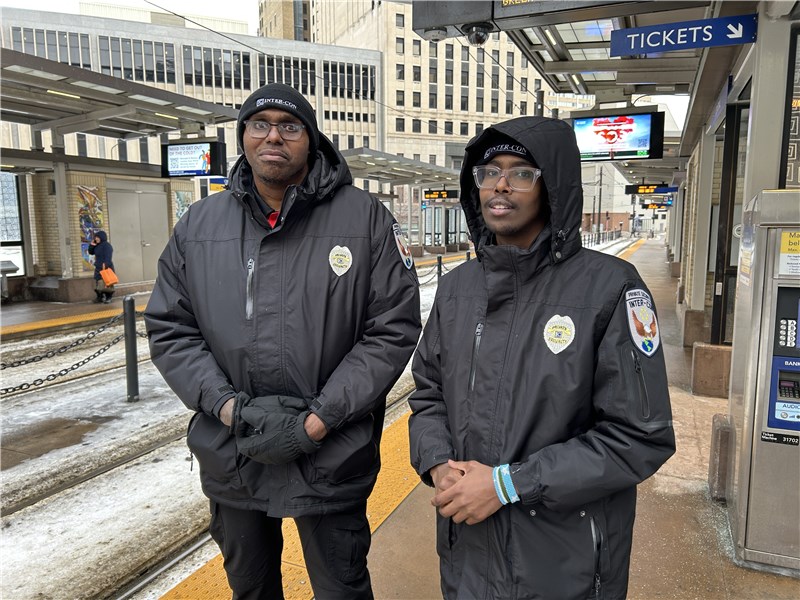
Expanding our official presence on transit is a cornerstone of our work to provide a consistently safe, clean, and welcoming experience on transit.
That includes having supplemental security officers at some of our busiest boarding areas to help people feel safe in their surroundings and alert us when more help is needed.
At the beginning of 2025, our security footprint expanded through a new contract with Inter-Con Security, a firm that provides security services at transit agencies across the country.
Here’s what you need to know about the use of security officers on our system.
What roles and responsibilities do security officers have on transit?
Security officers are one of the official layers or presence on the Metro Transit system.
Security officers are in place primarily to monitor conditions at stations and ensure people are observing rules for riding while on transit property (i.e. not smoking or playing loud music on transit property).
Security officers have been trained to de-escalate and will contact Metro Transit police if someone is breaking the law or posing a safety risk.
When and where will security officers be present?
Security officers are at more than two dozen locations to varying degrees.
They are a 20- to 24-hour daily presence at some of our busiest locations, including the Brooklyn Center Transit Center, the I-35W & Lake Street Transit Station, and the Snelling Avenue, Central, Franklin Avenue, 46th Street and Lake Street/Midtown light rail stations.
Throughout the day, security officers also visit light rail stations in downtown Minneapolis, downtown St. Paul, and at the MSP Airport terminals.
At the end of each day, security officers check on boarding areas like the I-35W & 46th Street Station in Minneapolis and the Maplewood Mall Transit Center.
Security officers can also accompany teams of Transit Rider Investment Program (TRIP) Agents who ride light rail and bus rapid transit lines to assist riders and inspect fares. While most TRIP Agents are Metro Transit employees, some Inter-Con Security employees also serve as TRIP Agents.
How were locations chosen?
Locations with security officers were selected based on customer and employee feedback, calls for police service, and reported property damage. These same metrics will be used to guide any future changes made to our deployment strategy.
What do security officers wear and carry?
Security officers can be identified by their black uniforms that have a patch. They are required to carry pepper spray and handcuffs.
How can feedback be provided?
Security officers are hired, trained, and supervised by the contractor who follows state regulations related to security services. Any feedback we receive will be shared with the contractor for appropriate follow-up. Comments can be submitted here or by emailing [email protected].
What else are you doing to strengthen official presence on transit?
We are continuously recruiting police officers, Community Service Officers, and TRIP Agents and are working to enter into new contracts with community-based organizations focused on issues like substance abuse disorders and unsheltered homelessness. On transit, representatives from these organizations will be asked to make referrals and offer resources.
Learn more about all our layers of presence