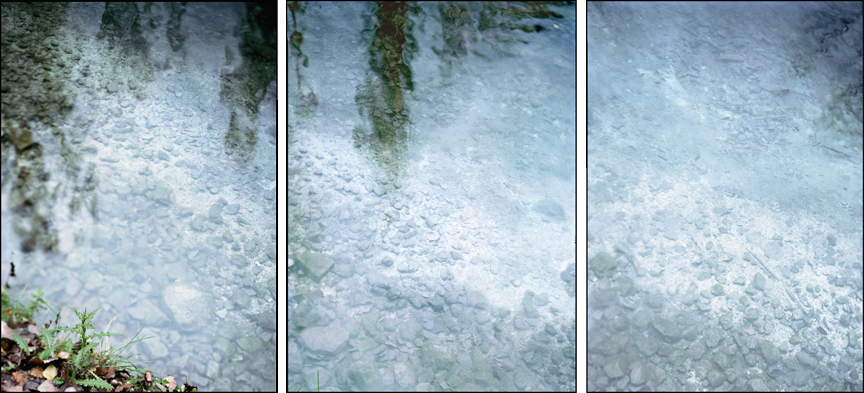
JoAnn Verburg is an American photographer who uses large format cameras to shoot life-size portraits, still life's and landscapes. Verburg’s images create narrative sequences that generate a state of prolonged experience; not a state of motion, but, rather, how we view images, as in mirroring the eye’s movement during the act of looking.
She made a name for herself in the late 1970s with “The Rephotographic Survey Project,” a collaborative exhibition and book that recreated more than 120 images of largely uninhabited Western landscapes in the 19th century. Using cameras, lenses and film that approximated the technology of their 19th-century predecessors, they waited for weather conditions that replicated the light in the original photographs, then rephotographed each place. The resulting then-and-now comparisons showed what the passage of time had done to those vistas. Surprisingly, what endured — the same trees, boulders and riverbeds — was often just as poignant as the changes to the landscape over time.
Verburg studied at Ohio Wesleyan University, earning her Bachelor’s of Arts in Sociology. She earned her Masters of Fine Art in Photography from the Rochester Institute of Photography, New York. Verburg moved to Minnesota in 1981 where she was an artist-in-residence at the Minneapolis College of Art and Design. She splits her time between St. Paul, Minnesota and Spoleto, Italy.
JoAnn Verburg's website