How can the B Line move people faster?
A key B Line project goal is to improve travel times by approximately 20% compared to the existing Route 21. Standard BRT improvements will combine to reduce various sources of delay. These include:
-
Increased stop spacing
- Efficient stop placement
- Off-board fare payment
- All-door boarding
However, preliminary analysis indicates that further improvements through bus priority treatments will be necessary to reach the project’s goals for speed and reliability.
Bus priority treatments can be implemented in different ways at different locations. Learn more about specific types of bus priority treatments being considered for the B Line (PDF).
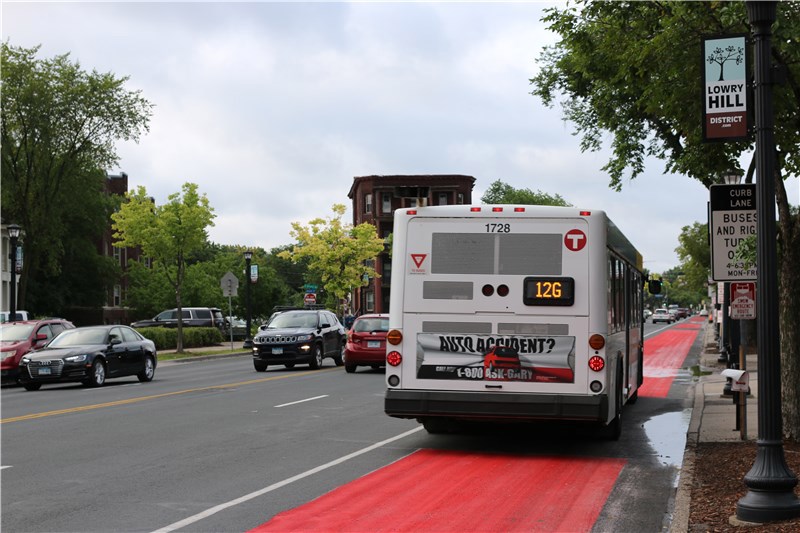
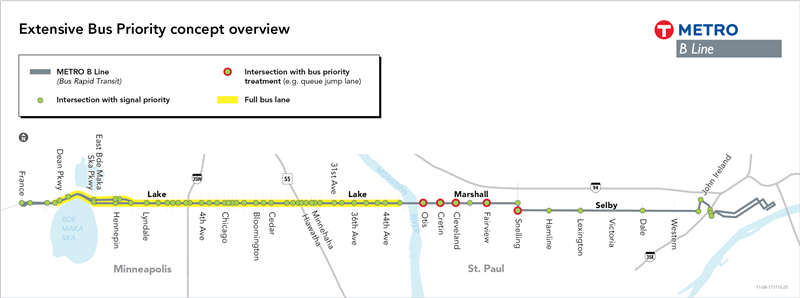
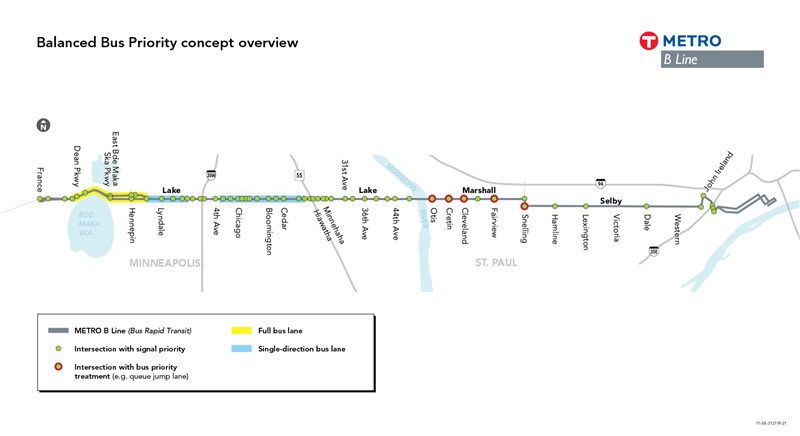
To better understand how different packages of bus priority treatments could be implemented across the entire B Line corridor, Metro Transit developed two initial bus priority concepts: a Limited Bus Priority concept and an Extensive Bus Priority concept. Working closely with Hennepin County and the City of Minneapolis, Metro Transit developed a third scenario that would include bus priority treatments along with coordinated roadway changes to address other agency goals for the corridor, including measures to improve traffic safety and bicycle connections along portions of the Lake Street corridor while attaining acceptable traffic operations. This scenario, called the Balanced Bus Priority concept, is also described below.
Limited Bus Priority concept
Extensive Bus Priority concept
Balanced Bus Priority
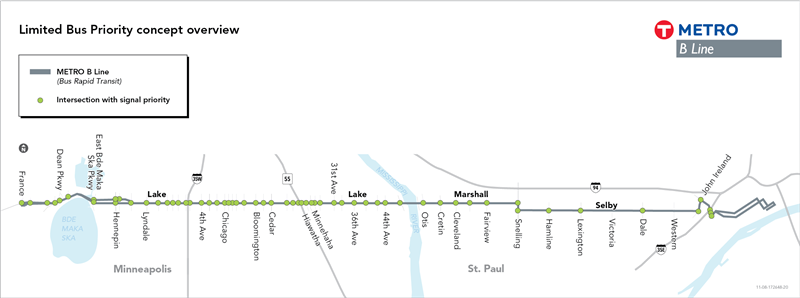
The Limited Bus Priority concept is focused on modifying traffic signals to provide more “green” time to buses passing through intersections.
The Extensive Bus Priority concept retains traffic signal modifications but adds roadway changes in a number of locations across the corridor.
The Balanced Bus Priority concept combines measures to improve transit speed and reliability for the B Line with roadway changes intended to address broader City and County goals for the corridor, including traffic safety and bicycle connections.
Recommendations for B Line bus priority treatments will continue to be refined and finalized as the project moves through planning and engineering. Because Metro Transit does not own or operate streets, any changes would need to be made in partnership with the corridor cities and counties.
B Line Corridor Plan